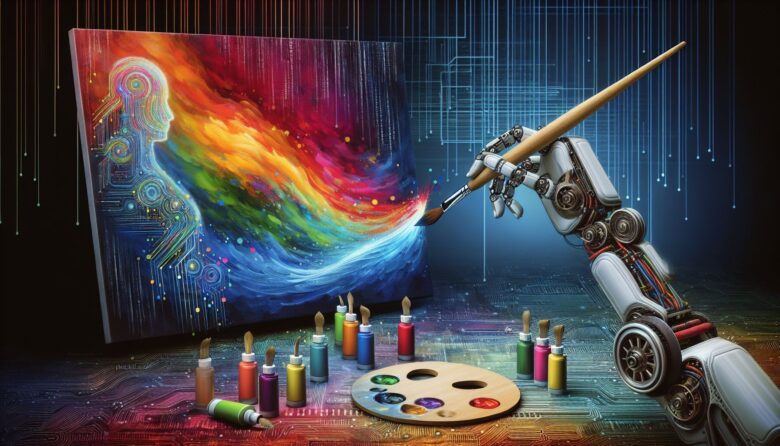
Hey there, tech aficionados and fellow machine lovers! Let me tell you, something mind-boggling happened to me last week. I stumbled upon an art exhibition, which was unusual because, let’s face it, I’m not exactly the “appreciate-the-finer-things” type. But this wasn’t your typical head-scratching, abstract-art kind of exhibition. This was a showcase of works created entirely by AI. Cue jaw drop. We’ve got some serious virtual Van Goghs in the making, folks. Let’s dive into this blend of silicon and creativity and explore just where this mind-bender is taking us.
AI: The New Renaissance Artist in Silicon
The Palette of Neural Networks
Now, if you’re picturing a clunky robot holding a paintbrush, stop right there. We’re dealing with algorithms, sophisticated little devils like Generative Adversarial Networks (GANs). These aren’t just tinkering at the edges of creativity. They’re full-on splattering it across the digital canvas. Picture it: a GAN is like having a painter and a critic in one. One part creates the image, and the other critiques it until, voila, a masterpiece emerges. And we’re not talking random doodles here. Anyone seen those “AI versions” of famous paintings? Jaw dropping.
Beyond Random Pixels
This is where it gets wild. Initially, AI art mostly looked like someone sat on a glitchy pixelation button. But now, these neural networks pull in styles from all over history and mix them with modern themes. We’re talking everything from David Hockney to Banksy. I saw a piece that mashed up the brushstrokes of Monet with the digital aesthetics of cyberpunk, and honestly, I wondered if any human could’ve painted something so harmonious.
The (Sometimes Blurry) Line Between Human and Machine
Can Machines Really Be Creative?
Alright, here’s the million-dollar question: Can something born out of code be genuinely creative? Creativity has been our sacred space, right? But here’s where it gets funky. Creativity may not be as uniquely human as we assumed. It turns out, it’s all about connections, between neurons or lines of code. AI pieces have sold for staggering sums, and museums worldwide are curating them. Is it creativity when a machine combines hundreds of style matrices to produce a work that feels remarkable to a human? Maybe. I’m as mixed up as a blender about it, but it sure does shake up our definitions.
A Shift in Art Ownership
One unexpected side effect? It’s changing who gets to be an artist. You, me, your tech-challenged aunt, everyone. With the right algorithm, any of us can dip our toes into the creative pool. And that’s liberating, isn’t it? Sure, we can argue about the soul of the art, but democratizing creativity, that’s powerful. Just as platforms like Instagram turned everyone into a potential photographer, AI is leveling the playing field for creators.
The Future Canvas: Great Art or Just a Trend?
Exploring New Artistic Frontiers
So, what’s next? Are artists going to go extinct like the poor dodo bird? Nah, I doubt it. Art is evolving, not dying. Artists are adapting, collaborating with AI to push boundaries unheard of in human history. We’re seeing collaborations between tech startups and traditional artists, producing immersive installations combining digital and physical worlds. Think virtual reality paintings or AI sculptures that change depending on who views them. Mind blown!
Legal Pandora’s Box
But hold your creative horses. There’s a storm brewing in the legal world. When we talk ownership and copyright… oy vey! If an AI creates a totally original masterpiece, who owns it? The developer? The AI? This whole debate is like unraveling a legal ball of yarn. And more than just legal, it strikes at the heart of authorship. Who gets the credit? The coder nerd in a hoodie somewhere, or the machine humming away in their home office? It’s like a soap opera, but with more zeros and ones.
Conclusion: The Brushstrokes of Tomorrow
At the end of the day, whether you think AI art is the uncanny valley’s revenge or the next Picasso emerges from a server room, it’s changing how we look at creativity. These systems force us to reflect, expand our horizons, and maybe even collaborate in unexpected ways. You’re either eyeing this innovation with skepticism or great hope, or maybe a mix of both.
As for me? I’m excited. Yes, it’s unknown territory. Yes, it feels a little like “2001: A Space Odyssey” sometimes. But we’re human. Exploration and invention are in our DNA. So, here’s to embracing the digital artists of tomorrow, those silicon Picassos, leaning into the marvel of their creativity, a creativity born from code. Let’s keep our eyes open and our minds curious. What an exhilarating time to be alive!